Aly Dijkstra-Kruit giving makes happy
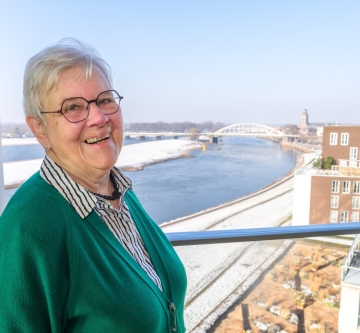
Aly Dijkstra-Kruit is 83 years old, lives in Deventer and is an alumna of the University of Groningen. She has been supporting the Ubbo Emmius Fund (UEF) for many years. Her commitment to education, equal opportunities and academic research has been a constant theme throughout her life. She has also included the UEF in her will, as has her husband.
Education and first steps in teaching
Aly grew up in the Groningen peat colonies, in a family where continuing education was a priority, even though her parents themselves did not have the chance to pursue further studies. “For them, one thing was certain,” she says. “If at all possible, our children must continue their education.” They succeeded: one son became a vet, the other a violinist. Aly herself found her way to a degree in social psychology in Groningen through a HBS-B and teacher training college.
In Groningen, she became actively involved in the student movement. She joined the Student Trade Union and later served as education secretary on the board of the Groningen Student Council. “I’ve actually always held administrative roles,” she says. “From the pupils’ association at the age of fourteen to national committees.” After graduating, she worked at the educational research group at Utrecht University. During an internship in educational research in Eindhoven, she met her husband Lieuwe, who, like her, had studied in Groningen.
In the 1970s, Aly moved into practical educational reform and became project leader of a secondary school experiment. Later, she worked at an educational study centre, where she was involved in teacher training and advising school management. She remained active in education and research until her retirement; board positions remained a regular part of her life.
Active even after retirement
Aly remained active even after her retirement. She held various board positions, now including roles within her owners’ association, and volunteers for the Deventer City Archives. As a member of the Deventer Building History Working Group, she is involved in researching old houses in the city centre, carrying out archival research into former owners and writing the reports. She also feels a connection to art and culture, an interest that has long been part of her life. This interest ties in with her passion for history and heritage.
How she became involved with the UEF
The first step towards the Ubbo Emmius Fund came via a familiar face. “Geert Sanders, the first director of the UEF and a former fellow student, visited us to ask if we would like to contribute to the restoration of the Allersmaborg, owned by the University of Groningen.” The aim was to turn the manor into a meeting place for students, alumni and researchers.
Aly and Lieuwe decided to contribute and subsequently continued to support the university on a regular basis through the Eric Bleumink Fund (EBF), one of the funds within the Ubbo Emmius Fund. They also included the UEF in their wills.
“My motivation is simple,” says Aly. “To improve educational opportunities for young people who would otherwise not have them. I still see talent being wasted due to misguided school recommendations, particularly among children from migrant backgrounds.”
The EBF, which awards scholarships to students from low-income countries, therefore appealed to her immediately. “You’re not just giving someone the chance to study, but also to take that knowledge back to their own country. I think that’s important.”
What giving means to her
“Giving is rewarding,” she says. “You see what is achieved with it. When I read interviews with students who have received a scholarship, I think: I’ve contributed a little to that too.”
She supports several organisations, but remains critical. “Every five years, I review which causes I continue to support. I dropped an organisation that had completely outsourced the processing of donations. That felt too impersonal.”
An unexpected twist in a legacy
Aly and her husband had no children, but both had jobs. “We were in a better financial position than the average family. You can leave everything to heirs, but we felt they didn’t need it straight away.” That is why they chose to include charities in their wills through bequests, including the UEF.
After her husband’s death, his bequest was allocated to research at ERIBA, the European Research Institute for the Biology of Ageing. Later, Aly discovered that the researcher who was able to complete her PhD thanks to this bequest was her second cousin. “That was such an unexpected twist,” she says. “Completely unintentionally, it ended up within the family after all. That felt very special.”
Trust in how the funds are used
Aly herself has also included the UEF in her will. “After my death, the board may decide where the money can make the greatest difference, or make a proposal to the executor. As long as it goes towards good research: technical, medical or social. Free research without any pre-determined outcomes. Many major discoveries have come about in this way.”
For her, that trust is part and parcel of supporting science.
Giving brings joy
“You don’t have to be rich to be able to give something,” Aly concludes. “Small amounts make a big difference, especially when lots of people get involved. And it’s lovely to see what happens with your donation. That brings joy.”
