Computers as energy-efficient as brains
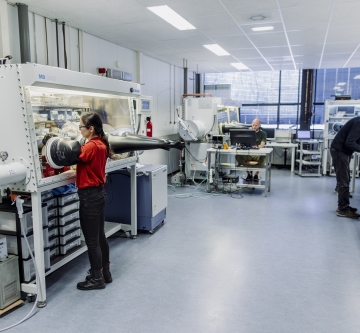
Advanced computer technology inspired by our brains: that is what CogniGron is working hard to achieve. Georgi Gaydadjiev is a professor within this Groningen consortium: ‘If we can filter out the basic principles of how the brain works, we will have something very special on our hands.
Data traffic in this digital age is increasing rapidly. So rapidly, in fact, that our computers can barely keep up with this development. What's more, these devices require a lot of energy to process all this data. Already, more than ten percent of global energy demand is accounted for by ICT. To make our society future-proof, we therefore need a whole new type of computer, based on completely different principles. That is the proposition of CogniGron, a top-level collective in Groningen, funded by the Ubbo Emmius Fund. Within CogniGron, twenty-two professors and more than a hundred lecturers, PhD students and master's students from all over the world are working together on the development of the super-efficient, super-powerful computers of the future. One of those professors is engineer Georgi Gaydadjiev, originally from Bulgaria but now living in the Netherlands for more than thirty years – with a few interludes in England and Sweden. He explains, carefully phrasing his words in very fluent Dutch, what CogniGron is all about and why he is so enthusiastic about it. ‘The most remarkable thing about this work? We combine principles from mathematics, artificial intelligence, materials science, computer science and neuroscience. That is a truly unique approach.
Where did this new approach come from? Scientists have been working on a quantum computer that will solve everything for a long time, haven't they?
'That's right. Ultimately, a quantum computer will also perform calculations in a completely different way than our current computers. But the problem is that quantum physics, the theory on which that computer is based, is still very much in development. The work on it is still very fundamental. And that's why its application is still quite a long way off, perhaps another twenty years. We are looking for a solution for the meantime. A solution that can also do certain things that a quantum computer is not suitable for.
What does that solution consist of?
‘We are looking for a combination of specific material properties and principles from brain science to be able to perform certain calculations. Ultimately, this will result in a system that only responds to relevant signal changes from its environment, just like our brains. The brain does not constantly process all the information that comes in – if it did, we would go mad and get nothing done. No, for example, I see something moving, and only then will part of my brain spring into action to perform the corresponding, very specific information processing. That is what brain-inspired computing will do too. And that is much more efficient than current computers.
‘We combine principles from mathematics, artificial intelligence, materials science, computer science and brain science. That is a truly unique approach.
What kind of materials are these?
‘They are materials with certain combinations of, for example, electrical, magnetic and thermal properties. We combine our knowledge of these materials – an area in which Groningen has long been a leader – with knowledge from all these other disciplines. That is what makes this work so unique. But please understand me correctly: we do not want to build artificial brains. We want to understand the basic principles of information processing in the brain and use them for efficient data processing. How is it possible, for example, that our brains are so fast, so powerful and efficient, and have such a large memory, while using so little energy?
But we only know a fraction of how the brain works... Isn't that frustrating?
'No, no, no! That's precisely the challenge! Finding something, creating something that offers a solution to a real social problem, based on how things are organised in nature. Nature has succeeded. Of course, it took millions of years, but that was thanks to certain basic principles. If we can filter those out, we will have something very special on our hands. That's what makes this work so much fun."
Is it realistic to think this will work?
‘As an engineer, I always want to break problems down into feasible projects as much as possible. Projects that will really make a difference – not only for science, but also for society. I don't think we're going to find a generic solution, a complete cognitive supercomputer that can do everything. We are therefore focusing on a specific function, or a specific set of functions, with which we are unravelling more and more basic principles. Ultimately, we will arrive at a generic solution. And in the meantime, we can already fit those small pieces of the puzzle into current computers to make them much better. And that's what we're already doing. That's the beauty of it.
What applications are now coming into view?
‘Take weather and climate models, for example. They are becoming increasingly dynamic and complex. That is why they process more and more data, with ever higher resolution in space and time. We are already reaching our limits in this regard. If, for example, you want to predict tomorrow's weather very accurately, a computer will need a week to perform the calculations. That means the forecast would be too late to be of any use. This is even more true for global climate models, which look at larger areas and, above all, longer periods of time. Current models are not yet capable of doing this with sufficient accuracy.
Can you give another example?
‘There are also many possible applications in the medical world. Based on measurements, doctors want to offer patients increasingly targeted and personalised treatments. This also requires ever-increasing computing power. Take, for example, a cancer patient undergoing radiation therapy. The doctor uses a scan to irradiate only the tumour with great precision, and not the surrounding healthy tissue. The doctor uses that one scan for a whole series of radiation treatments over several weeks. But we know that organs are not static in the body: they sometimes change position and orientation. You would actually have to scan a patient during radiation treatment. This requires much more powerful computing power than computers can currently handle.
But will this really be possible before the quantum computer is available?
‘Yes, I am 100 per cent convinced of that. We can certainly make this last example a reality within five to ten years. We are already well on our way. I cannot emphasise enough that CogniGron is truly a pioneer in Europe. There are very few initiatives that bring together the knowledge and capabilities of all these disciplines so effectively. Groningen can be really proud of that.
