How much can we ask of residents
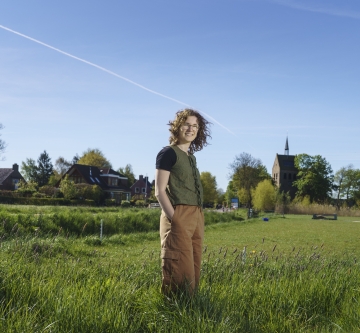
How can rural communities remain vibrant when local services disappear and increasing responsibility falls on residents? In her PhD research, Lieselot Vroom explores how community-led initiatives contribute to the liveability of villages in the Northern Netherlands, as well as the challenges they face. Her research highlights the indispensable role of engaged citizens, while raising an important question: how much can we reasonably expect from local communities?
How much can we ask of residents?
In a village where the supermarket is closing down and healthcare is becoming increasingly out of reach, something striking often happens: people take matters into their own hands. They set up an energy cooperative, organise mutual support and ensure that things keep running. Lieselot Vroom recognises the power of this. 'A lot is happening,' she says. 'People are taking the initiative, often because they want to keep their village liveable.' As her research progressed, she noticed that one question kept coming up. Because how naturally does this really develop, and how much effort can you expect from people?
What emerges when people take matters into their own hands
For her research, Vroom spoke to professionals, policymakers and residents who are themselves involved in initiatives in Groningen, Friesland and Drenthe. She saw just how broad the spectrum is. On the one hand, there are energy projects, such as solar panels and wind turbines, the proceeds of which flow back to the village; on the other, initiatives much closer to everyday life, such as morning coffee meetups, support for informal caregivers or someone to help with shopping. 'It can be anything,' says Vroom. 'Sometimes very practical, sometimes more social.' What stands out is that initiatives work particularly well when they genuinely emerge from the grassroots. 'When it comes from the residents themselves, you see it come to life.'
Where it gets complicated
At the same time, these are no small tasks. Care and energy initiatives touch on systems that are normally organised by the government, and that is precisely where it gets complicated. 'People are very positive about residents’ initiatives,' says Vroom, 'but when it comes to larger issues, you also hear: we can’t do this alone.' In practice, she notices that initiatives sometimes get bogged down because things become complex. Regulations, grants and coordination with local authorities take time and energy, meaning people are sometimes primarily occupied with organising rather than with the cause they are working for. 'That can be quite frustrating,' she says.
Who carries the load
Another factor is that the work often falls to a small group. It is usually the same people who take the lead, hold meetings, make plans and bear responsibility, whilst other residents do help but more often in a limited way, for example with an activity or a specific task. This creates an uneven distribution. 'You see that a small group does a great deal,' says Vroom, 'and that can become quite a burden.' In some cases, people have to stop because it becomes too much, and then suddenly something that the village relied on is lost.
Not every village is the same
What works varies greatly from village to village. In communities where people are already used to organising things together, initiatives often get off the ground more easily. Unfortunately, that is not the case everywhere, and not everyone has the time or energy to commit long-term. 'People also have their jobs and their families,' says Vroom. 'So you might ask yourself: should you really expect this?' That question touches on something more fundamental than just practicalities, namely what is reasonable and fair.
The conversation that is needed
For Vroom, this is the crux of her research. Not in finding a single solution, but in bringing that tension to light and the conversation that goes with it. 'I hope this helps to get the conversation going,' she says, 'between residents and, for example, the local council, about what we actually expect from one another.' It is precisely those expectations that often remain implicit, meaning initiatives and local councils do not always manage to find common ground. 'Sometimes things just don’t run smoothly,' she says. 'And then you realise you’re working at cross-purposes.' By actually having that conversation, it becomes clearer what is feasible and where the boundaries lie. 'You really have to look at each village individually: what’s possible here?' says Vroom. 'And when should the local authorities simply take matters into their own hands?'
About this research
This research is made possible by the Ubbo Emmius Fund. The fund encourages young talent to contribute ideas for solutions to urgent social issues and helps to translate insights from research into practice. By becoming a Friend or Supporter, you too can contribute to research at the University of Groningen. Curious? Read more.
