How to use AI as a co-creator – rather than a replacement of humans
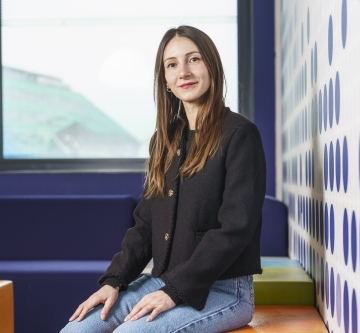
The use of artificial intelligence (AI) is making our lives easier in many domains. It also raises fundamental questions. In a PhD project funded by the Ubbo Emmius Foundation, Sinem Mustacoglu is studying how AI in the creative domain is affecting us. 'We have to make sure that humans stay closely involved in the creation process.'
'Technology affects us in ways that we often don’t realize', says Sinem Mustacoglu. 'A new technology can have the power to change everything. The way we think, the way we interact, our culture, our daily lives… It enables us, but it also limits us.' This has been true throughout human history, but today, with the rise of artificial intelligence (AI), the discussion about its opportunities, downsides, and even threats, is increasingly in the news.
'I am particularly interested in how AI affects creativity, or the way we create', says Sinem. This is the focus of her PhD project within the Ubbo Emmius Foundation’s M20 programme, which funds interdisciplinary research into major societal challenges. 'I really like this interdisciplinary aspect. If you want to study the interactions between humans and AI, you need to know about sociology: how the technology affects our society. You need to know how media and communications work. And you need a cognitive and behavioral angle, looking at things like cognition, perception and emotion.'
Although she has a background in all three of these disciplines, it is the latter that currently has her main interest. 'In my project, I use mixed-methods, behavioral and neurophysiological approaches, to study how humans react to AI. How they interact and co-create with it.'
At the start of her professional journey, Sinem aspired to work in journalism or copywriting. She tried her hand at this for several years in corporate environments. 'But the more I moved in these circles, the more I got fascinated by more academic questions. How do media and communications affect society? And, increasingly, what is the role of AI in this?'
Seeing the Groningen PhD project advertised on EURAXESS, the European platform that connects researchers with jobs, felt like the chance of a lifetime, as Sinem recalls: 'This project combines exactly what I’m interested in, from the micro-level – how an individual reacts to technology – to the larger impact on society. I was super happy when I got the position. I still am', she adds smilingly. 'And I also really enjoy Groningen as a city.'
Stylistic averages
AI changes the way we create, as Sinem points out. It sounds logical, and it is in fact what she is seeing in her experiments. 'But what’s still less well understood is how this affects human agency, human autonomy, and eventually the output.' ‘Human agency’ is the capacity of an individual to make their own choices and act through conscious, goal-oriented actions. It is this aspect that is most often seen as threatened by AI. But the output aspect should not be neglected either, argues Sinem – especially in the creative sector.
'Take AI-generated paintings, for instance, or essays, or stories', she explains. 'AI is trained on the basis of likelihood. Hence, it uses stylistic averages. This is what we call the homogenization problem. At the moment, we’re not adequately equipped to understand what this will do to human creative culture.'
After all, as Sinem emphasizes, art is not intended to be liked by everyone. Sometimes it is the innovative, unexpected or even provocative art that moves and inspires us the most. Sinem: 'So, we don’t know what AI will do to human culture in the long term.'
And then there’s a bias problem: AI is often trained within specific contexts, such as Western art, literature or journalism. This underrepresents the styles, histories and values of other regions in the world.
Thirdly, AI introduces the concept of misinformation, not just in writings but also in images. 'If art becomes untrustworthy, this will have a profound effect on how people relate to it', says the researcher. 'This is why, as we put it, we need to ‘keep humans in the loop’. We have to make sure that humans stay closely involved in the creation process. In other words, AI should be made more human-centered.'
Emotional responses
To make this possible, more knowledge is needed about how humans value and react to AI-created artistic content. Sinem’s research aims to contribute to that. 'There are different ways in which we study this', explains Sinem. 'By interviewing people, by letting them self-report on their experiences, and also by measuring their emotional responses. We can measure things like heart rate, blood pressure and pupil dilation. But also focus and attention span.'
This is why Sinem’s project is a close collaboration between the Faculty of Behavioral and Social Sciences (Psychology Department) and the Faculty of Science and Engineering (Math, Computer Science and AI). 'Computer scientists would love to build AI that is more user-friendly, more human-like, and more truly collaborative, true to how people think and create', says Sinem. 'However, their expertise typically lies outside behavioral and cognitive domains. And the other way around: our expertise does not typically focus on the technical workings of AI. That is why this interdisciplinary work is so important. It works two ways.'
Enable transparency
When making AI more human-like, one interesting question emerges, as Sinem is quick to point out: won’t this make it even harder to distinguish between human- and AI-generated art, between truth and ‘fake’ information? 'This research will contribute to ways to regulate the level of AI involvement', she notes. 'There are ways to ethically involve AI, by using it as a co-creator, not the sole creator, of work. By ensuring that the AI brings out the best in its user, rather than being a replacement. This will be important in all domains, from medicine to engineering, but it will especially be needed in the creative domain. This is where you want to keep ‘humans in the loop’. But it’s also one of the most problematic domains in which to control AI.'
Therefore, more research is also needed into adequate regulation. 'A lot of research is being done, for instance by the EU, but it focuses on ‘deep fakes’ and cybersecurity. My research is different, but it also touches on some of the same questions: how do we enable transparency in what AI is doing?'
Just a tool
Sinem concludes with the remark that she started with: every technology has its challenges. 'With AI, we are just at the beginning of this journey. Who knows what AI will look like 10 years from now, let alone 25 years… Perhaps it will have been replaced by an entirely new technology.' Would her research still matter in that case? 'Absolutely. Research always builds on top of earlier research.'
And she has one last remark: 'There is so much negative news about AI. We have to be careful about a negative bias. After all, AI is just a tool. How it affects us is determined by how we use it. That is what my research hopes to improve.'
Sinem Mustacoglu (Türkiye, 1990) studied sociology in Istanbul and Copenhagen, media and communication systems in Istanbul, and cognitive science in Vienna. She then worked as a research assistant for several universities and a consultancy firm. Sinem is now doing PhD research at the University of Groningen’s Heyman’s Institute for Psychological Research.
