Een ‘pracademicus’ met idealen: 'Je moet uitgaan van de capaciteiten van mensen'
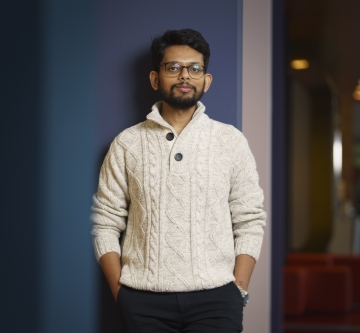
Rupankar Dey* from India is doing PhD research in Groningen, supported by the Ubbo Emmius Foundation. He studies social complexities that arise from prejudiced notions – particularly about women with disabilities – in rural Africa. 'In order to address inequalities, we need to understand the underlying factors.'
How does a young academic from India end up in Groningen, studying women’s reproductive health rights in Uganda? Rupankar Dey smiles broadly at the question. 'Indeed, it’s been quite a journey', he says while pouring coffee in a meeting room at the Faculty of Spatial Sciences.
To share his remarkable journey, Rupankar starts at the very beginning: when he was around seven years old. 'My granddad was a refugee from Bangladesh. His stories were the first set of things that made me politically conscious. And then there were the books I read. I loved reading books, I still do. I owe this to my mom: she shaped my upbringing through books.'
It was like a chain reaction: the more Rupankar read, the more he wanted to know, the more he wanted to read. 'Over the years, I got fascinated by how societies develop, and the political and cultural forces behind this. How multiple social tensions are created due to the interests of a few. How different beliefs and colonialism have shaped our modern time.'
Rupankar dreamed about contributing to society in the way that suited him best: as a thinker, through intellectual means, following the example of famous philosophers. 'My mother encouraged me. She wrote on a piece of paper: ‘You will be a scholar one day’, and then stuck the note to my mirror so I could see it every day. She wasn’t pressuring me – it was in a sweet and supportive way.'
Research in Uganda
Rupankar decided to study history in Calcutta. 'I want to understand present-day challenges in society, like poverty and inequality and gender-related issues, and help make society more liveable. I think that in order to do that, you need to understand the past.' Following his bachelor’s degree, he moved to the Netherlands, for a masters’ degree in development studies at the Erasmus University of Rotterdam.
From the very beginning of his undergraduate studies, Rupankar has been active in development initiatives. 'I worked on fundraising and campaigns on water and sanitation in rural India, through a local NGO', he says. 'For the Liliane Fund, in a project funded by the Dutch Ministry of Foreign Affairs, I did a research internship focusing on women’s access to reproductive health services in Uganda. This is how I became involved with Africa.'
Following his master’s in Rotterdam, Rupankar started a PhD at the University of Groningen in 2024. It was funded through the organization RAISE Global Health. Barely six months into his programme, his funding was halted abruptly due to a shift in the geopolitical climate. 'It looked like I might lose my job and house', he recalls. 'I continued my research, but it was a very stressful period. Then colleagues in my research group told me about the Ubbo Emmius Foundation, and encouraged me to write a letter to them – which I did. The Fund adopted me and my project! It was a miracle.'
Unravel all the factors
Academically, but mostly through his NGO experiences, Rupankar became interested in how people’s socioeconomic identity translates into their access to healthcare, particularly in rural areas. 'Throughout history, women have faced multiple societal vulnerabilities', he notes. 'Among them, there are groups that are even more vulnerable, for instance because they have a disability. People with disabilities are often seen through a paternalistic lens, with the assumption that they lack the capability to do things. Their strengths and abilities are overlooked. In my research, I want to unravel all these beliefs and prejudices, all these social dynamics and complexities, with the aim to promote equality.'
Rupankar’s research has shown that women with disabilities are usually well equipped to make their own decisions, realize their needs and take control of their lives. 'However, the key to achieving this is social support that acknowledges their strengths and abilities', he says. 'And this should go beyond simply providing a friendly infrastructure.'
No ‘one size fits all’
Within ‘access to healthcare’, Rupankar particularly looks at sexual and reproductive rights and healthcare. From his field visit, he shares the story of a young woman he met in Uganda, who had an intellectual disability. 'She worked in a bakery, earned her own money and took good care of herself. The thing she wanted most in life was to become a mother. But her own mother deemed her unfit to have children. So the mother arranged for her daughter to receive contraception, without this young woman being aware of this. This shows that ‘agency’, being able to make your own decisions, is not only shaped by money or social support, but also by other people’s perceptions of disability.'
And there are many other factors that affect agency and access to healthcare, as Rupankar explains. Social status, religion, cultural values and norms… 'There is no ‘one size fits all’, he concludes. 'Current government and NGO programmes often disregard this truth. They work top-down, starting from their own beliefs. If we want to help people, we need to understand all of the underlying factors, and then work bottom-up. Ask the people what they need.'
Get the discussion started
That is what Rupankar hopes his research will contribute to: a better understanding of realities, away from engrained notions that are often centuries old and laden with traditional, patriarchal, and often colonial views. 'I hope that having these truths on the table will get the discussion started', he says. 'Societal change often takes decades to become visible, and this holds true for many major transitions. For example, braille was initially overlooked by many. However, through the advocacy and lived experiences of blind people, it is now recognized as a vital tool for accessibility and inclusion.'
Looking ahead at his own options, Rupankar is sure that he wants to pursue an academic career. 'I want to help advance the science of social complexities', he summarizes. 'But I’d like to combine it with practical work, like consulting, in the field. I consider myself a ‘pracademic’ – an academic in practice. It’s out there that I want to make a difference.'
* Rupankar Dey (India, 2000) studied history at the University of Calcutta and development studies at the Erasmus University of Rotterdam. He is currently doing PhD research at the Population Research Centre (Faculty of Spatial Sciences) of the University of Groningen. Rupankar taught and developed courses at the International Institute of Social Studies in The Hague, and did research for the Liliane Fund in Den Bosch, RAISE Global Health in Amsterdam, and the WE Program in The Hague.
