An overloaded electricity grid: more than just a technical problem
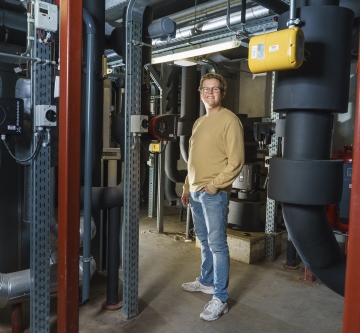
How do we allocate scarce grid capacity? What choices do we make in doing so, and what are the consequences? At the University of Groningen, PhD candidate Rik Keppel* is investigating how data, economic incentives and policy together steer the use of the electricity grid. His PhD research, part of the Wubbo Ockels School for Energy and Climate and made possible by the Ubbo Emmius Fund, does not focus on a single technical solution, but on understanding the system as a whole. Because only when it is clear how decisions play out in practice does it become apparent where opportunities arise.
An overloaded electricity grid: more than just a technical problem
The energy transition is changing not only how we generate energy, but also how we use it. Electricity is increasingly in demand at the same time: in the early evening, when cars are being charged, heat pumps kick in and households are consuming plenty of power. This puts pressure on a system that is not designed for it.
This tension raises fundamental questions. How do we allocate scarce grid capacity? What choices do we make in doing so, and what are the consequences? At the University of Groningen, PhD candidate Rik Keppel is investigating how data, economic incentives and policy together steer the use of the electricity grid.
His PhD research, part of the Wubbo Ockels School for Energy and Climate and made possible by the Ubbo Emmius Fund, does not focus on a single technical solution, but on understanding the system as a whole. Because only when it is clear how decisions play out in practice does it become apparent where opportunities arise.
More than a technical issue
'The electricity grid is often approached as a technical problem,' says Rik. 'But in practice, it’s just as much about choices. Who gets access to the grid, when, and under what conditions?'
He developed this broader perspective whilst working in recycling technology. There, he saw how sustainability targets sometimes turn out differently in practice than intended. 'There are many good plans,' he says, 'but they don’t always work as expected. That got me thinking: where does it get stuck?'
That question forms the starting point of his PhD research. Instead of developing a single solution, Rik is trying to understand how decisions regarding prices, regulations and behaviour collectively influence usage on the electricity grid.
Flexibility in a full system
An important part of his research is the role of large energy users, such as hospitals or industrial companies. These parties often have more flexibility than is currently utilised. By temporarily storing energy or planning processes differently, they can draw less power during peak times.
'If a large consumer makes room at such a moment,' explains Rik, 'it creates capacity for others in the area. For example, for a supermarket or a residential area. That might seem like a small intervention, but at the system level it can make a big difference.'
Rik is investigating under what circumstances such flexibility is actually utilised. In doing so, he looks not only at what is technically possible, but also at financial incentives and the way in which regulations encourage or, conversely, hinder this behaviour.
From measurements to understanding
In his research, Rik combines data on energy prices, consumption and grid capacity. He processes this into a model that provides insight into the consequences of different choices. What happens if electricity becomes more expensive during peak hours? Who adapts their behaviour, and who doesn’t? And what does that mean for the load the grid bears?
'Many decisions are currently being made without these kinds of effects being clearly visible,' says Rik. 'My aim is not to formulate policy, but to better understand what happens when you tweak certain parameters.'
The model is intended to help policymakers, grid operators and major energy consumers make better-informed choices, particularly in a context where simple solutions are often lacking.
Cross-disciplinary collaboration
The research is structured as a collaboration across different disciplines. From Science and Engineering, Stephan Trenn contributes expertise in systems and control engineering. From Economics and Business Administration, Marco Haan and Orest Iftime guide the project using their expertise in market dynamics and applied mathematics.
'Engineers often look at what is physically possible, economists at what works financially,' says Haan. 'But the problem lies somewhere in between. If you don’t connect those perspectives, you miss part of the story.'
Rik recognises this. 'It sometimes takes time to understand each other’s language,' he says. 'But that’s precisely why you start to look at the same problem differently. That interaction strengthens the research.'
Significance for society
Grid congestion has become a daily news item. Businesses cannot expand, housing construction is being delayed and renewable energy generation is sometimes being held back. At the same time, expanding the grid is costly and time-consuming.
Rik’s research shows that within the existing system there is scope to manage capacity more intelligently, provided that choices are properly understood and substantiated. Not as a replacement for technical investments, but as a complement to them.
For the Ubbo Emmius Fund, this aligns with the aim of the M20 grant: to support young researchers who work across disciplinary boundaries on contemporary societal issues. By bringing together different perspectives, the knowledge needed to make progress is created.
Network congestion is not going to disappear in the coming years. That makes it all the more important to understand how existing capacity is used and which choices are decisive in this regard.
'The energy transition ultimately revolves around choices,' says Rik. 'My research helps to better understand what those choices mean.'
About this research
This research is made possible by the Ubbo Emmius Fund. The fund supports young talent who contribute ideas for solutions to urgent societal issues and helps to translate research insights into practice. By becoming a Friend or Supporter, you too can contribute to research at the University of Groningen. Curious? Read more.
*Rik Keppel (Netherlands, 2000) studied Industrial Engineering and Management at the University of Groningen. After graduating, he worked in recycling technology, where he focused on energy data and sustainability in practice. Since 2025, he has been conducting PhD research at the University of Groningen within the Wubbo Ockels School for Energy and Climate. His research focuses on the smarter utilisation of grid capacity in an overloaded electricity grid.
Text: Djoeke Bakker
