How virtual reality helps young people to truly understand climate change
For many Dutch school pupils, climate change is an abstract concept. They know it exists and are concerned about it, but they hardly feel its effects in their daily lives. The dykes keep the water out; life goes on. It is precisely this distance that makes it difficult to empathise with people who are confronted with the consequences of climate change on a daily basis.
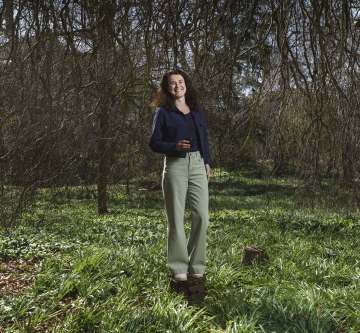
PhD candidate Marit Boekema is investigating how this can be changed. In her research she examines how virtual reality can contribute to climate citizenship in secondary education. She wants to help pupils learn to understand other people’s perspectives and reflect on their own role in a changing world.
Climate citizenship starts with perspective
'At its core, my research is about sustainability education,' says Boekema. 'The central question is how we can teach young people to adopt the perspective of people who are confronted with climate change on a daily basis worldwide. Climate change affects people, animals and ecosystems worldwide, but the consequences are not distributed fairly.'
The Netherlands is one of the richest countries in the world, whilst the worst consequences often fall on people who contribute the least to the problem. 'It’s hard for young people to imagine that. They’ve never been there, they don’t have those experiences. So it remains a distant reality.'
It is precisely here that Boekema sees a role for education. According to her, climate citizenship is about awareness, responsibility and the realisation that individual behaviour is part of a bigger picture.
A journey to another reality with VR glasses
In her research, Boekema uses virtual reality. Pupils put on VR glasses and are transported to vulnerable areas, such as small islands facing sea-level rise. They see how people there live, reside and cope with changes in their environment.
'Through VR glasses, your brain finds it difficult to distinguish between the real world and a virtual world. As a result, it feels as though you are actually somewhere else. That is fundamentally different from a text or a video,' she explains. 'My research examines whether that experience changes anything in how pupils think, feel and reflect on climate change.'
She is curious to see whether VR helps in adopting a different perspective and in developing climate citizenship.
What young people already know and what remains abstract
In an initial study, Boekema administered questionnaires to around 700 secondary school pupils, spread across different levels and regions. She also interviewed pupils aged fourteen to sixteen (year 10).
'You can see that many young people are aware of climate change and a large proportion are concerned. At the same time, young people partly think the problem lies in the future, whilst we are already in the thick of it. The link between the major problem and their own actions is often not yet strongly established.'
That attitude varies from pupil to pupil, but the pattern is recognisable. Climate change is vast, complex and sometimes overwhelming. That makes it difficult to get a grip on it.
Research right in the classroom
Boekema works closely with schools and teachers. Nineteen secondary schools in the Netherlands took part in the first phase. The data from that study has now been collected and is currently being analysed. 'I’ll be able to say more about the results in the near future,' she says. 'But the ultimate goal is broader than just figures. I want to understand what effect this approach has on pupils and whether it helps teachers to make this topic discussable.' After the summer, the next phase will begin, in which we will work with teachers on teaching methods. How can VR be integrated into lessons in a practical way? How does it fit in with pupils’ experiences and different learning levels? Building bridges between theory and practice
The fact that Boekema herself spent years in the classroom as a history teacher helps in this regard. 'I know how demanding teaching is. Every innovation demands something extra. That’s why I think it’s important that this research is feasible and aligns with practice.'
Her experience as an education policy officer also plays a part. 'I can switch between research, policy and the classroom. Building bridges is perhaps the very essence of my role.'
The project is also highly multidisciplinary. Researchers from behavioural sciences, educational sciences, climate science and engineering are working together. 'Such collaboration is essential, particularly when it comes to sustainability. In education, this still happens too rarely, even though the subject demands it.'
No right answers, but room for questions
What Boekema hopes for above all is that pupils learn to reflect. 'Regardless of their attitude. Even if a pupil says: ‘I’m not really worried about it,’ that’s fine. The point is that there is space to think, ask questions and express feelings.'
After VR experiences, she often hears reactions such as: 'I didn’t know this existed too.' She sees that alone as a gain. 'It broadens their perspective.'
In her view, it is important not to overwhelm young people with fear or guilt. Climate change is drastic, especially for a generation growing up with it. 'The question is how to discuss this topic without making people feel powerless. How do you remain hopeful, without denying the severity of the situation.'
Small steps matter
Climate citizenship doesn’t mean everyone has to become an activist. 'Not everyone is Greta Thunberg. But small choices matter. Eating less meat, having conversations, being mindful of how we use things. Individual actions contribute to public support.'
From a historical perspective, Boekema also sees reason for hope. 'A lot has changed over the past fifty years. We are in the midst of a transition. The question is not whether change will come, but whether we are implementing it quickly enough.'
When will this research be considered a success
For Boekema, her research is already valuable. 'I am in close contact with schools and teachers who really want to get to grips with this. If this research gives them tools and gets young people thinking, then it’s worthwhile.'
'Ultimately, it’s about working together towards a world that remains liveable. If this research contributes to raising awareness, sparking conversations and bringing about small changes, then that is hugely valuable.'
About this research
This research is made possible by the Ubbo Emmius Fund. The fund encourages young talent to contribute ideas on solutions to urgent social issues and helps to translate insights from research into practice. By becoming a Friend or Supporter, you too can contribute to research at the University of Groningen. Curious? Read more.
