More than trees: the complex challenge of greening cities
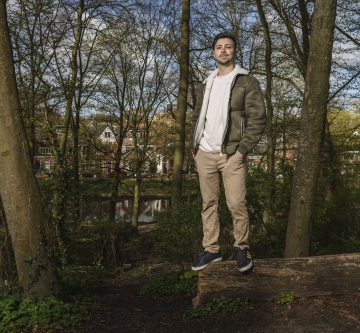
‘Greening the city’ is a buzz term in the context of climate resilience. But how do you do this effectively? Sergio Velez Triana* looks at biological and social factors that make green spaces a success. It is a tremendously complex puzzle. 'It’s crazy. Insane. But we need to at least try to understand all these perspectives, to make better decisions in the end.'
How do nature and culture relate to each other? Are they part of each other, or do they exist separately? And what does this mean for how people treat nature – and each other – in relation to nature conservation? These rather philosophical questions have practical implications around the world. PhD student Sergio Velez Triana, who grew up in the Colombian Andes, has always been interested in these discussions.
'During my bachelor’s studies in ecology, I worked with peasant communities in rural Colombia', he says. 'There I saw first-hand how nature conservation sometimes affects people’s livelihoods and creates injustices. This caught my attention: nature conservation has so many sides that many people don’t realize.' This is when Sergio decided to dedicate his studies to these questions: how to reconcile nature and culture? How to better use traditional ecological knowledge in nature conservation, and better involve local people in the process? 'The ultimate goal for me is to ensure more social environmental justice.'
Playing with the proposal
Following his bachelor's degree, Sergio looked for opportunities abroad. An interdisciplinary geography master in Leuven, Belgium, offered just what he was looking for: a combination of social sciences, physical geography, and political ecology, plus an opportunity to write his thesis based on data collected in Colombia. 'This was fantastic', he says. 'Working on the topic that I felt so closely connected to, and in an international and interdisciplinary environment.'
This exact combination is what Sergio found in Groningen as well. Following his master’s degree, and some time working on projects in Colombia, he was granted a position in the University’s M20 programme. This PhD programme, funded by the Ubbo Emmius Foundation, aims to contribute to major societal challenges through interdisciplinary research. 'What I liked was that I was able to play with the proposal and adapt it to my interests. I had some pretty crazy ideas, but apparently the supervisors liked it.'
What is access?
In his project, Sergio studies how to create and improve green spaces in order to make cities more resilient against climate change. 'This sounds easier than it is', he emphasizes. 'It’s not just a question of planting a few trees. In order to ‘green’ a city in a truly efficient way, you need to take into account ecological and social factors.'
Ideally, a green space in a city includes a wide range of biodiversity – for instance: grass, shrubs and trees; birds, insects, mammals and soil organisms – to make it ecologically stable and truly climate-resilient. 'An important question here is: how do species have access to these green places? What is it that allows them to reach and thrive in urban areas?' To address this, Sergio is first developing a theoretical framework that captures ecological characteristics of plant species.
'But what is access, actually, and how do we expand the concept from plants to animals and humans? How can all stakeholders be included in the greening process and have true access to the environmental resources?'
Ecosystem view
In short, in his theoretical framework Sergio hopes to also include socio-economic characteristics of cities. 'This is not just about rights – for instance people’s right to a liveable environment. It is also about their economic capacity, and about decision-making processes.' Here it gets more complicated, as Sergio points out with an almost mischievous twinkle in his eyes. 'People can be important players in shaping green spaces, but other species too. So we need a truly integrated ecosystem view to come up with effective solutions and better processes.'
But he laughs as he realizes how philosophical and complicated this sounds. Incorporating everything in a single theoretical framework, from plant traits to socio-economic structures? Sergio seems both confident and modest at the same time: 'I work with a fantastic and experienced team of supervisors, who I value very highly: my daily supervisor Daniella Vos from Cultural Geography; Casper van der Kooi at the Faculty of Science and Engineering; Ward Rauws from Spatial Planning; and Wander Jager at the University College. So yes, I think together we can do this.'
Sergio will conduct interviews with policy makers, city planners and residents. As his research progresses, he aims to make sure that the results are communicated back to all these stakeholders. 'We don’t want it to stay in academia. We want it to actually make a difference.'
And what will this difference be? What will be the concrete, visible outcome? 'First of all, ideally, this will lead to plans for ‘greening the city’ that are more ecologically inclusive – in other words, that include a wide range of biodiversity and are therefore more climate-resilient', says Sergio, 'and that are more socially inclusive. The result will be green spaces that really contribute to climate adaptation, as well as to social and environmental justice.'
Embrace the challenge
Sergio has already started mapping Groningen’s green spaces, describing their structure and species composition. 'Some larger and older parks, like the Noorderplantsoen, but also in Helpman, are structurally complex', he says. 'They have a wide range of species, organized in many different layers, which makes them relatively resilient. But some smaller areas have only grass, making them more vulnerable to climate change.' And it is hard for other species to reach these places, he adds. 'Also, in many places the planners have opted for non-native species. Not ideal, from an ecosystem perspective. But sometimes there are valid reasons to choose these species. Or valid reasons not to have shrubs, for instance, due to safety considerations. Human perspectives cannot be ignored.'
Again, he laughs at the complexity of his research. 'It is crazy. Insane. But we need to at least try to understand all these perspectives, to make better decisions at the end. And it’s also the fun part: trying to embrace the challenge.'
With over three years left in the project, Sergio finds it hard to predict what he aspires to do in the future. 'My ideas tend to change a lot', he says with a smile. 'Before, I used to say I would never do a PhD. And yet here I am, and I am loving it. But after this? I’ve always liked the idea of working with communities. I think I can do that in an academic setting but also through an NGO, for instance. So time will tell.'
* Sergio Velez Triana (Colombia, 1996) studied ecology at the Universidad Javeriana (Colombia) and geography at KU Leuven (Belgium). In 2025, he started his interdisciplinary PhD research at the M20 programme of the University of Groningen. Sergio studies how both human and non-human stakeholders access and experience green urban spaces, hoping to contribute to more resilient cities.
About this research
This research is made possible by the Ubbo Emmius Fund. The fund encourages young talent to contribute ideas on solutions to urgent social issues and helps to translate insights from research into practice. By becoming a Friend or Supporter, you too can contribute to research at the University of Groningen. Curious? For more contact, please contact Elise Kamphuis at 06-11808809 or via email at e.kamphuis@rug.nl.
