Early signs of sepsis: “Sometimes a doctor wants to send someone home, but my test results suggest otherwise”
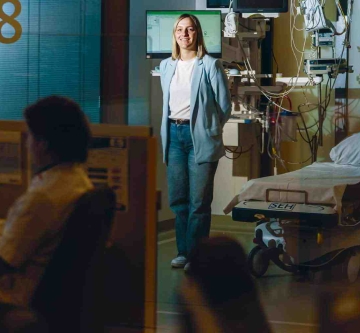
Sepsis, or blood poisoning, is difficult to recognise in time. And that is precisely what makes it dangerous. Researcher Britt Coenen is working on a method that could change all that. Using tiny diamonds, she can sometimes spot what’s going wrong even before a patient actually looks ill. “That’s really the whole idea,” she says. “We want to be able to intervene earlier, before any damage is done.”
Diamonds as a measuring tool
In sepsis, the immune system reacts so violently to an infection that the body starts to attack itself. What begins as something relatively minor, such as pneumonia, a small wound or a urinary tract infection, can trigger a chain reaction throughout the body. Organs become damaged and patients can become seriously ill or even die.
Worldwide, around 50 million people develop sepsis every year. “And someone dies from it every few seconds,” says Britt. The main problem lies in the timing. The initial signs are often vague: a slight fever, a rapid heartbeat, or simply not feeling well. “By the time those symptoms become clear, the body is actually already lagging behind,” she explains. “The damage has often already begun.”
To change that, Britt is working with nanodiamonds: extremely small diamond particles measuring just a few nanometres in size. “They can, as it were, ‘sense’ what is happening in their surroundings,” she says. This is because they react to certain substances released during an immune response, such as free oxygen radicals – a kind of early warning signal from the immune system. In the lab, she mixes these diamond particles with patients’ blood cells. By measuring how the diamond particles react, she gains insight into how active the immune system is and, above all, how early this becomes apparent. “What we’re seeing is that sometimes you can already detect something before a patient actually starts experiencing symptoms.”
A&E
At the UMCG, Coenen assesses patients arriving at A&E with a suspected infection. “We carry out the test within an hour,” she says. “There have been times when a doctor thought: this patient can go home. But my test showed something different.” It is precisely these borderline cases that are important, she explains. Not the patients who are clearly very ill, but those whose condition could still go either way. “Those are the moments that make all the difference.” Faster and more accurate detection has another advantage: more targeted treatment. At present, many patients are given antibiotics as a precaution, because doctors do not want to take the risk. But this contributes to a growing problem: antibiotic resistance
From lab to practice
The technology behind the tiny diamonds has been around for some time, but its use on patient samples is new. The research has progressed rapidly over the past few years. Whereas work initially involved large, complex laboratory set-ups, there is now a fairly compact device in the A&E department. Nevertheless, it is not yet a standard test in the hospital. For that to happen, the method must first be extensively tested and validated. “You want to be absolutely sure that it’s always accurate, in every situation,” says Coenen. “And that takes time.” She is also already looking further ahead. Because the next question is just as interesting: why does one patient develop sepsis whilst another does not? What makes her work special for Coenen is the combination of fundamental research and direct application. “Everything I do is ultimately for the patient.” That direct link makes the work tangible. “You see what it’s all about. That’s what keeps you going.”
Britt Coenen works as a researcher at HTRIC (the Health Technology Research and Innovation Cluster). HTRIC is helping to shape the future of our healthcare system. They bring together academic research, health technology and clinical practice to tackle the challenges facing the current healthcare system. It is one of the largest projects ever made possible by the Ubbo Emmius Fund.
This research is funded by the Ubbo Emmius Fund (UEF). With the support of its donors, the fund enables research and teaching at the University of Groningen. Would you like to contribute? Visit uef.nl/schenken and become a Friend or Supporter.
